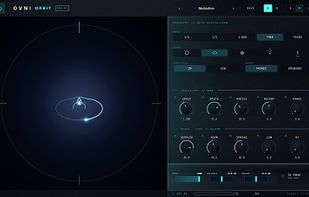
ORBIT takes a source, sums it to a single mono point, and flies it on a real path around the listener's head. It is a variable-position HRIR spatializer: two bracketing HRIR voices crossfade with a fractional-delay ITD, so the source moves without clicks or zipper noise. Below one meter it applies Duda-Martens near-field proximity, which brings the bass bloom and the asymmetric ear shadow that make a close source feel close rather than just loud. HEIGHT is a spectral tilt used as an up/down cue, not a true elevation — the trajectory itself runs on the horizontal plane.
Its Doppler is not a pitch-shifter: the pitch rise and fall emerge from modulating the propagation delay, the same way they do outdoors. A Chaos control makes the trajectory erratic without making it random, and Rate can run free, lock to the host tempo from a quarter note to a bar, or hold a fixed placement.
For externalization, a Room control adds decorrelated early reflections that lower interaural coherence and push the image outside the head. For speakers, ORBIT switches to RACE crosstalk cancellation. An IN PHASE switch drops the widening entirely for a clean mono sum, and a stereo-linked sample-peak limiter holds the internal peak at -1.4 dBFS. It ships with 40 factory presets, and it is the engine the rest of the OVNI catalog was built from.
On latency, stated exactly: ORBIT reports 0 samples of delay to the host at any sample rate, and the wet path carries its own delay — 31 samples, and 453 samples when DOPPLER is above 0 — which is not PDC-compensated. The manual says the same thing.
ORBIT is released under the GNU AGPLv3. The code is free forever and anyone can build it; the ready-made installers are free to download until November 23, 2026 and paid after that (US$15 for the pack of eight OVNI plug-ins). VST3 and AU on macOS 11 or later (universal, Apple Silicon and Intel), VST3 on 64-bit Windows 10 or later. The macOS installer is signed and notarized by Apple; no iLok, no account, no online activation.








 ovniaudio added OVNI ORBIT as alternative to atmoky trueSpatial, Steam Audio and Resonance Audio
 OVNI Audio

