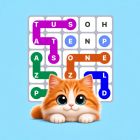
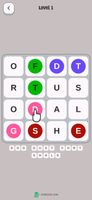
The board is not a soup of letters with words hidden in it — it is words all the way down. Each one snakes through the grid, turning wherever it likes, and together they cover every single cell exactly once. That changes how you read it: a letter you cannot place is not filler, it is a piece of a word you have not found yet.
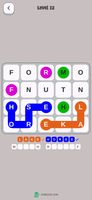
Only the ends are marked. Two dots of the same colour are the head and tail of one word, and your job is to work out the path between them — how many turns it takes, which letters it swallows on the way. Draw it right and the snake fills in behind your finger.
The help fades as you go. Early boards colour every pair of ends and show the words below; later the colours drop away, then the words shorten to their first and last letters, then to a single letter, and finally to nothing at all. By then you are reading the grid itself.
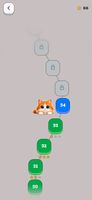
Three thousand levels climb from a four-by-four square with three short words to a nine-by-ten grid packed with a dozen, and the dictionary is nouns only — no articles, no verb forms, no abbreviations, so a word you cannot see is still a word you know.
Two daily modes sit beside the campaign: a five-level themed survival run on one subject with three lives for the whole run, and a single streak level that keeps a counter going as long as you come back.









 crokocat
