




opencode
55 likes
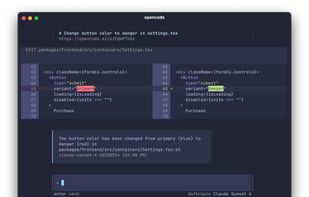
Terminal-based AI coding assistant featuring a themed native UI, automatic LSP integration, multi-agent sessions, 75+ supported LLMs, local and cloud model options, shareable debugging links, open source licensing, and session sharing for collaborative coding workflows.

Cost / License
- Free
- Open Source (MIT)
Application type
Platforms
- Mac
- Windows
- Linux

Features


opencode News & Activities
Highlights All activities
Recent News
- Fla published news article about opencode
 OpenCode Desktop adds tabbed sessions for improved workflow
OpenCode Desktop now features tabbed sessions, allowing users to start new sessions or open existin...

Recent activities
 Shavva-Varshith-Reddy added opencode as alternative to ARIA Repository Intelligence
- catmuf liked opencode
- OKTAYMERCAN liked opencode
 Pung-Worathiti-Manosroi added opencode as alternative to Superagent
 Trendle added opencode as alternative to DeepSeek Harness


Featured in Lists

A list with 23 apps by justarandom without a description.
List by Darlene Sonalder with 23 apps, updated
A list with 9 apps by rainman without a description.
List by rainman with 9 apps, updated

my software list, mostly open-source.I have used the vast majority of the software listed there myself for a long...
List by phantomfancy with 132 apps, updated
What is opencode?
opencode information
Developed by
 Anomaly Innovations
 Licensing
Open Source (MIT) and Free product.Written in
Rating
Average rating of 4.5Alternatives
112 alternatives listedBadge
Get an embeddable badge for opencodeSupported Languages

AlternativeTo Categories
Development, AI Tools & Services, OS & UtilitiesGitHub repository
- 207,348 Stars
- 27,196 Forks
- 5802 Open Issues
- Updated


Comments and Reviews
Main thing is - OpenCode is powered by energized and very responsive team. They do care about all the github issues ppl are posting. This is incredible and rare nowadays to see the response to your issue within hours.
The product itself is just amazing FOSS alternative not only to Claude Code or OpenAI's Codex, but also to all the rest CLI AI agent coding tools:
With deep respect and love to all the talented folks in the dev team! You guys are driving changes forward.
LLMs has been around for 3 years already and only now we have a product that is really easy and fun to use to make things happen.
Incredibly useful and efficient. Would 100% recommend. Agent management is excellent, tool calls are well balanced, and the overall quality of the generated code and reasoning has been consistently good in my experience. The context handling feels solid, task delegation between agents is one of the best implementations I've used, and the workflow is fast enough to stay out of your way while coding.
The UI is still a bit unfinished, but it's already intuitive, responsive, and easy to navigate. Configuration is straightforward, and support for custom providers makes it very flexible. The project also has a clean architecture and is pleasant to use for both small tasks and larger codebases.
My main criticism is that some features still feel like they're evolving, and the documentation could be more complete in a few areas. Occasionally, the interface lacks the polish of more mature tools, and a few quality-of-life improvements would make the experience even better.
Overall, it's an impressive project with a lot of potential. It's already become one of my favorite AI coding tools, and I'm excited to see how it continues to improve.
Globally, very solid agentic AI coding client, especially for people transititioning into FOSS from proprietary services like Github Copilot. For power users, a central problem is hardcoding. The system prompt in opencode cannot be easily modified. Although the system prompt is fine for vanilla use, for power users with lots of MCP servers offering tools superseding opencode defaults in efficiency and precision, the hard-coded system prompt is a real dragger, as AI models get confused from conflicting system and agent/user prompts on which tool to use.
A side note, the free models shipped with opencode are good for testing opencode out and working on simple personal projects. They are however unfit for production. Those models are heavily quantised, and the performances are way below the published benchmarks. Opencode could have made this clearer, but they don't want to, because currently their revenue depends wholely on opencode Go, a 10$/mo subscription offering model APIs at heavily discounted rates that they are trying to sell to every opencode user. Expectedly, the models are heavily quantised.