




Servo
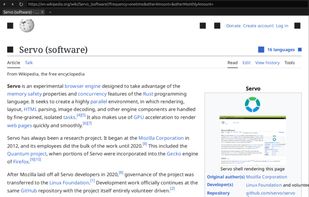
Memory-safe web rendering engine with modular architecture, parallel processing, advanced WebGL and WebGPU graphics, open-source license, cross-platform support for desktop, mobile, and embedded use cases, and independent embedding in diverse applications.

Cost / License
- Free
- Open Source (MPL-2.0)
Application type
 EU
EUPlatforms
- Mac
- Windows
- Linux
- Android
- Rust
- KaiOS
- Firefox OS


Features
Servo News & Activities
Recent News
- Fla published news article about Servo
 Servo 0.0.6 speeds up layout, enhances DevTools, and starts accessibility work
Servo 0.0.6 delivers major layout speedups with incremental rendering for box and fragment trees, i...
- POX published news article about Servo
 Browser rendering engine Servo launches first official 0.0.1 release on GitHub
The Servo project has published its first official release, version 0.0.1, introducing a new approa...
- Maoholguin published news article about Servo
 Servo latest update boosts speed, xPath, and adds dark mode & advanced CSS support
The latest updates to the Servo web browser engine have made the nightly builds faster, more reliab...


Recent activities
- catmuf liked Servo
- crse liked Servo
- Extropista added Lightweight as a feature to Servo
- martinligabue liked Servo
- niksavc liked Servo
- POX updated Servo
- POX updated Servo
- TBayAreaPat commented on Servo
The Servo engine program (Servo browser/ rendering engine) is mainly for software developers, browser engineers, and embedded‑systems teams.
- alternativeto-dingo898 liked Servo
- justarandom liked Servo
Featured in Lists
A more optimistic homage to the slopware catalog...
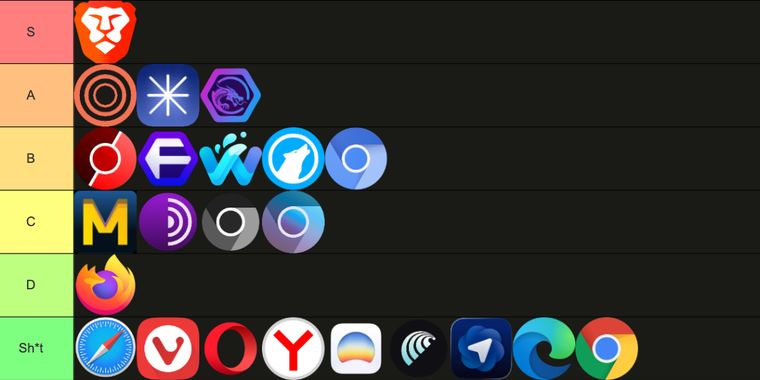
An up to date list of the best browsers Factors behind this selection: + Fast + Private/Security Focused + Open...

A list with 11 apps by ferenczy without a description.
What is Servo?
Servo information
Developed by
 Linux Foundation Europe
 Licensing
Open Source (MPL-2.0) and Free product.Written in
Rating
Average rating of 5Alternatives
11 alternatives listedNews
3 news article related to ServoBadge
Get an embeddable badge for ServoSupported Languages

AlternativeTo Category
Web BrowsersGitHub repository
- 38,009 Stars
- 3,798 Forks
- 3204 Open Issues
- Updated


Comments and Reviews
Servo, developed in Rust, represents a significant advance over traditional rendering engines such as Gecko and those derived from KHTML (WebKit, Blink, etc.) in key aspects such as security, performance and flexibility.
Rust, with its safe memory management and focus on concurrency and parallelism, provides Servo with a solid foundation that improves performance on multicore systems. By minimizing critical vulnerabilities such as buffer overflows and race conditions, Servo not only ensures more stable but also safer execution, particularly in high-performance environments.
Servo's modular architecture allows for a clear separation of responsibilities, making it easy to maintain and update individual components, such as the layout engine or CSS processing, without compromising overall performance. This modularity not only simplifies the integration of new technologies, but also allows for deeper customizations and adaptations to different platforms and use cases.
Servo's concurrent design maximizes parallelism, allowing essential tasks such as CSS parsing, layout, and rendering to run in separate threads. This enables optimal utilization of multicore architectures, significantly reducing loading times and improving scalability, especially on resource-constrained devices.
Freed from the limitations imposed by legacy architectural decisions, Servo is more agile in adopting and adapting to new web standards, ensuring greater compatibility and technological longevity. Its ability to run rendering processes simultaneously, backed by Rust's intrinsic security, positions it as a robust, advanced, and secure option for modern browser development and the future of the web.
Under the leadership of the Linux Foundation, Servo will benefit from a more open and collaborative approach, accelerating its development and innovation. This new direction, backed by industry collaboration and funding, promises to expand its adoption and ensure its long-term relevance in the web development ecosystem.
The Servo engine program (Servo browser/ rendering engine) is mainly for software developers, browser engineers, and embedded‑systems teams.